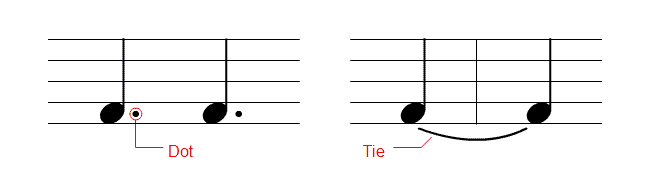
When reading music, you’ll see some notes which have dots on their right hand side, or are tied to another note of the same pitch. This post will be explaining what these signs mean.
Ties
A tie joins two same pitched notes together, like cement marrying two bricks.
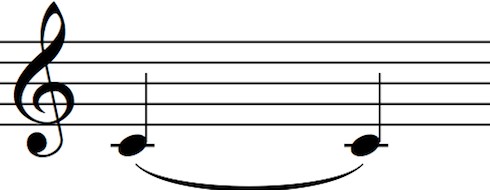
The above note would sound the same as this:
Both of the above examples would sound like this when played:
Why are notes tied?
There are a few reasons why composers tie notes:
- The note goes over a few beats, and it would be easier to count the note if it was separated into a few tied notes.

2. Likewise, notes can go over a few bars sometimes, so in these cases you have to use ties.
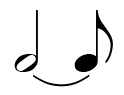
3. The note can’t be traditionally dotted (this will be explained below). For example, it consists of a minim and a quaver, a large note and a much smaller note, and dotting the minim wouldn’t work. So, you have to tie it.
Dots
A dot after a note, on its (bottom) right-hand side, lengthens it by a half, as shown by the image below.

For example, half a crotchet is a quaver. So, a dotted crotchet equals a crotchet plus a quaver. You see dotted notes in bars, especially in the main beats:

Here’s an example of both dotted and tied notes:

In a later post, we’ll explain legato (or slurred) and staccato notes, and how to tell the difference between legato notes and tied notes.
If you have any questions about this post, or if you have any new ideas, please email myblg.music.blog@gmail.com
If you would like to learn more about music and its impact on the world, follow Our Music Blog.
References:
Learn Music with +14 Rhythm Examples [Triplets, Dotted Notes, Staccato and More] (sessiontown.com)
Piano Lessons & Accompanist based in Dublin (jasonyangpianist.com)
A Music Crash Course v2 (davemyers.com)
The New Drummer – Your Drum Blog
Rhythm Primer Series for Guitarists: Ties in Music – StrumPatterns.com
pinterest.co.uk/pin/537265430524913628/
 Our Music Blog