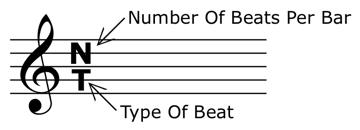
Time signatures are used in music to show how many beats there are in a bar:
- The top number represents the number of beats per bar.
- The bottom number equals the type of note (or, the length of the beat).
For example, take the 4/4 time signature, also known as Common time (C):

The 4 at the top symbolizes 4 beats per bar, and the bottom 4 shows that these beats are crotchets.
It’s crucial to understand notes values when learning time signatures; how the different notes relate to each other in terms of rhythm. The table below shows the values of the base numbers on the time signatures and their equivalent notes:
| Bottom number | (1) | 2 | 4 | 8 | 16 |
| Value | (Semi-breve) | Minim | Crotchet | Quaver | Semi-quaver |
| Symbol |  |  |  |  | 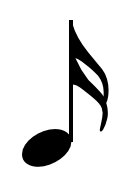 |
(The 1 and the semi-breve have been bracketed as there are no time signatures which use only 1 beat per bar). Can you see how as the bottom number doubles, the equivalent note value halves?
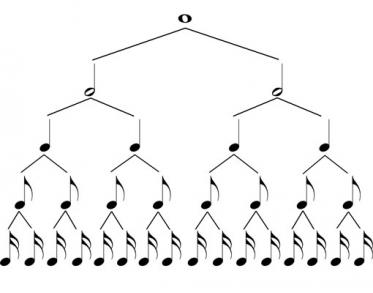
As the semi-breve equals 1, it makes sense that a crotchet is equals 4, as you can fit 4 crotchets in 1 semi-breve.
The top numbers of the time signature produce simple, compound, regular and irregular time signatures. To find out about these, subscribe and read on…
References:
http://www.creativeguitarstudio.com/images/lessons/time-signature.jpg
http://www.musicnotes.com/now/omg/12-cringeworthy-music-puns/
 Our Music Blog

